Water is an economic and political force that has been manipulated and exploited for power and control. All the while, it is one of the few salient features of the natural world that actualize the interpersonal relationship between humans and nature.
In this report, we will examine the Indus River System and its tributaries. First, we will analyze the history of the Indian subcontinent with an emphasis on Partition. We will then discuss how the Partition severed communities and the natural environment, specifically the Indus River System. Lastly, we will examine how the Partition led to transboundary water disputes and the subsequent pollution of the Indus system. In doing so, we hope to emphasize the political and social makeup of water and the histories attached to it.
The Partition of India
Prior to British colonization, the Indian subcontinent consisted of regional kingdoms known as princely states occupied by varying religious groups such as Hindus, Muslims Sikhs, Jains, Buddhists, Christians, Parsis, and Jews (Roy 2021). Each princely state maintained its own culture, traditions, and leadership. Then, in the 1500s, Europeans colonized India with “coastal trading settlements” (Roy 2021). The English East India Company soon became the “primary colonial power” in India (Roy 2021).
By the 19th century, the British categorized Indians based on religious identity and “[attached] political representation to them” (Tunzelmann 2017). Some scholars claim that religious categorizations propagated hostility amongst Hindus, Sikhs, and Muslims causing the polarization of religious groups. Alex von Tunzelmann states, “… many Indians stopped accepting the diversity of their own thoughts and began to ask themselves in which of the boxes they belonged”(2017).
The financial burdens of World War Two encouraged Britain to desert India (Dalrymple 2015; “India – Pakistan Relations” n.d.). Their departure, a haphazard endeavor, launched an ongoing consequence for the Indian subcontinent. In June 1947, the British declared a partition of India resulting in a Hindu-majority India and a Muslim-majority Pakistan (Dalrymple 2015; “India – Pakistan Relations” n.d.). Half of the subcontinent, along with 562 princely states, were left without British rule. “The provision was that each state could remain independent, join Pakistan, or accede to India” (“India – Pakistan Relations” n.d.). Families migrated to either Pakistan or India, seemingly based on religion (Kermani 2017).
Soon, the Indian subcontinent became “a terrifying outbreak of sectarian violence, with Hindus and Sikhs on one side and Muslims on the other — a mutual genocide as unexpected as it was unprecedented” (Dalrymple 2015). Nisid Hajari, author of Midnight’s Furies: The Deadly Legacy of India’s Partition (2017), states:
Gangs of killers set whole villages aflame, hacking to death men and children and the aged while carrying off young women to be raped. Some British soldiers and journalists who had witnessed the Nazi death camps claimed Partition’s brutalities were worse: pregnant women had their breasts cut off and babies hacked out of their bellies; infants were found literally roasted on spits.
British historian William Dalrymple (2015) states, “Partition is central to modern identity in the Indian subcontinent, as the Holocaust is to identity among Jews, branded painfully onto the regional consciousness by memories of almost unimaginable violence”. Pakistani historian Ayesha Jalal identified the partition as “the central historical event in twentieth century South Asia.” She writes, “A defining moment that is neither beginning nor end, partition continues to influence how the peoples and states of postcolonial South Asia envisage their past, present and future” (Dalrymple 2015).
The Partition of the Indus River System
The Partition not only severed communities, but also severed the natural environment, notably the Indus River System. The Indus System flows through India, Pakistan, and China’s Tibet region with six tributaries: the Indus, Jhelum, Chenab, Ravi, Beas, and Sutlej. Both India and Pakistan relied on the Indus System to manage their irrigation infrastructures (Thakur 2022).
In 1951, Pakistan and India asked the World Bank to finance their irrigation projects on the Indus System, prompting the World Bank to volunteer as a mediator for the countries (Thakur 2022). This resulted in the signing of the Indus Waters Treaty, which defined how the Indus River System would be divided (Thakur 2022).
Pakistan took the three western rivers: the Indus, Chenab, and Jhelum. India took the three eastern rivers: Ravi, Beas, and Sutlej. This permitted India to use Pakistan’s western rivers for agricultural purposes, allowed for the development of “run of the river” hydroelectric plants, and gave India control of upstream barrages (Braulik et al. 2015, 33, Thakur 2022).
Transboundary Water Disputes
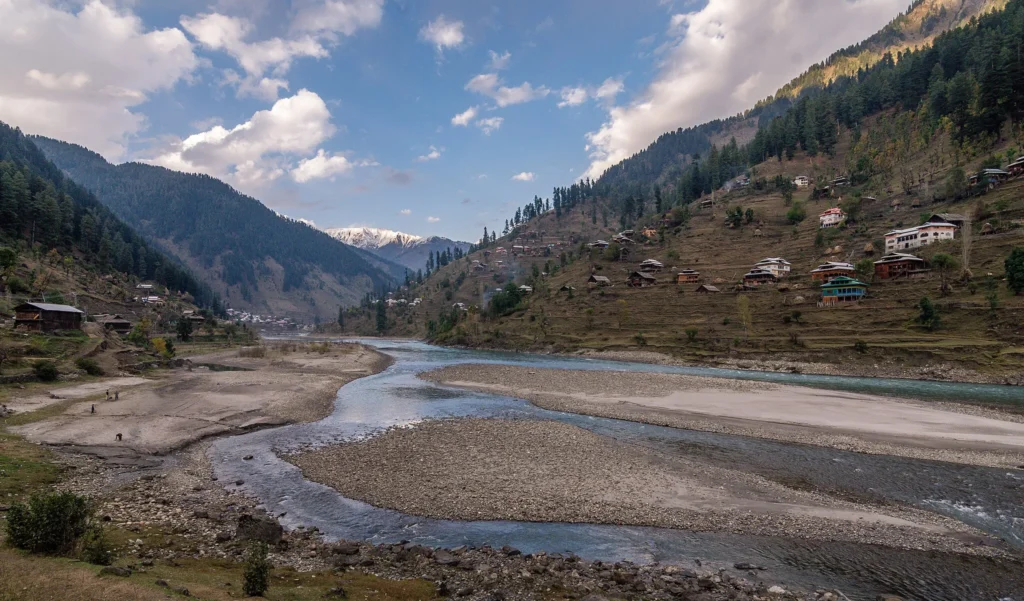
The Neelum River, a significant tributary of the Jhelum River, is encompassed within the provisions of the Indus Water Treaty (IWT) of 1960. This treaty grants Pakistan control over the Neelum, while allowing India to use it for non-consumptive purposes like hydroelectric power generation, as long as such use does not significantly reduce Pakistan’s water flow (“The Indus Water Treaty 1960,” World Bank Group 2022).
Two significant projects have emerged under this treaty framework:
- Neelum Jhelum Hydropower Project (NJHP) by Pakistan: Initiated to capitalize on the IWT provisions, Pakistan planned this project on the Neelum River in 1988, aiming to utilize water resources for hydroelectricity before India developed similar projects. This project sought to maximize the benefits accorded under the treaty (Directorate General of Audit).
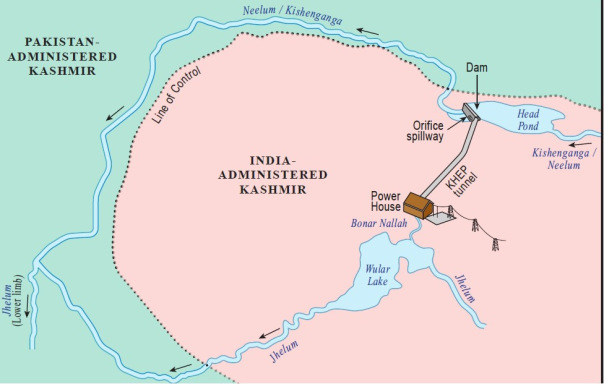
Kishanganga Hydroelectric Project by India: Commenced in 2007, this project on the Kishanganga River, called Neelum as it enters Pakistan, had a significant impact on Pakistan’s project. While India maintained the minimum flow of water as per treaty obligations (Khan 2013, Iqbal 2018),the project still led to reduced water flow to Pakistan’s downstream project, causing concern for Pakistan (Ahmad 2021). India’s dam reroutes Jhelum’s waters to an underground powerhouse preventing it from flowing into Pakistan (see Figure 1).