INFORM

Education for Sustainable Development

Our programs for students and teachers

Peter Braun

LEARNING EXPERIENCE MANAGER

Our hands-on educational program empowers participants to explore global responsibility, water justice, and sustainable consumption.

The textile industry is one of the world’s largest consumers of freshwater. This has serious ecological, health-related, and social consequences, particularly in the Global South. Our workshop for upper secondary education makes these interconnections tangible and demonstrates how global fashion consumption impacts water and climate justice.
Using interactive methods such as quizzes, simulations, and group work, we encourage critical thinking, empathy, and self-reflection. In this way, we make a concrete contribution to the implementation of Education for Sustainable Development (ESD) in the classroom.
“The workshop is a successful example of Education for Sustainable Development: it combines subject knowledge with reflection and real-life relevance. My class not only learned a great deal, but also gained a new perspective on global responsibility.”

Sonja Lyga-Räther

Lehrerin, Melanchthon Gymnasium

THE IMPACT

By the Numbers

0

Workshops Conducted

0 +

Students Participated

WHAT TO EXPECT

Our Workshop Program

Our workshop, “Between Consumption and the Water Crisis – How Fashion Makes Our Planet Thirsty,” can be integrated across subjects in the Berlin curriculum. In Politics/Economics, it covers global production chains and sustainable consumption; in Geography, it addresses water scarcity and environmental impacts; and in Biology, it explores effects on ecosystems and health. Engaging with global justice and responsibility also allows the workshop to be incorporated into Ethics and Social Studies. The applied methods further promote interdisciplinary skills in line with Education for Sustainable Development (ESD).
Welcome, Content Overview, and Energizer
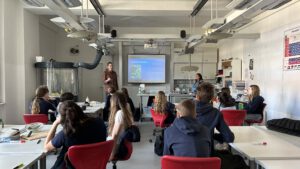
At the beginning of the workshop, our facilitators welcome the students, provide a brief overview of the workshop content, and lead an engaging energizer activity.
Next, the facilitators guide the students through an interactive knowledge quiz on the topic of “Freshwater.”
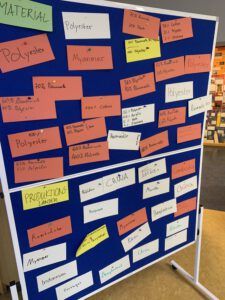
In a short video, students learn how water is used worldwide and the different forms of water consumption. The video prepares them for the activity “My Clothing,” in which students work in pairs to analyze the country of origin and materials of a garment they are wearing. They discover that textile production is often outsourced to countries in the Global South, due to factors such as low wages or weak environmental regulations. The activity also highlights the high water consumption in textile production and teaches that the “Made in” label only reflects the final production step, not the entire supply chain.
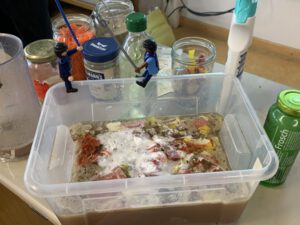
In this part, the facilitators present an example of a textile supply chain, from raw material production to disposal. It becomes clear that while the Global North benefits from consumption, the Global South bears the majority of ecological and social impacts. Afterwards, students work in small groups to simulate how different production stages contribute to river pollution. Using materials such as cooking oil, plastic, detergent, metal parts, or dyes, they make environmental consequences tangible and reflect on the global interconnections.
In a final session, students share their impressions, discuss ideas, and develop suggestions for more sustainable consumption practices. They are encouraged to formulate political demands and consider concrete steps for their own actions. This part of the workshop empowers students with a positive narrative, highlighting the many ways they can actively and sustainably shape the future.

Overview

Format: In-person Workshop
Duration: 90 minutes
Language: German
Location: Berlin-Brandenburg
Target Group: Upper secondary school students
Facilitators: Our workshops are led by facilitators with an academic and professional background in fashion

Scroll to Top