2. Preventive measures
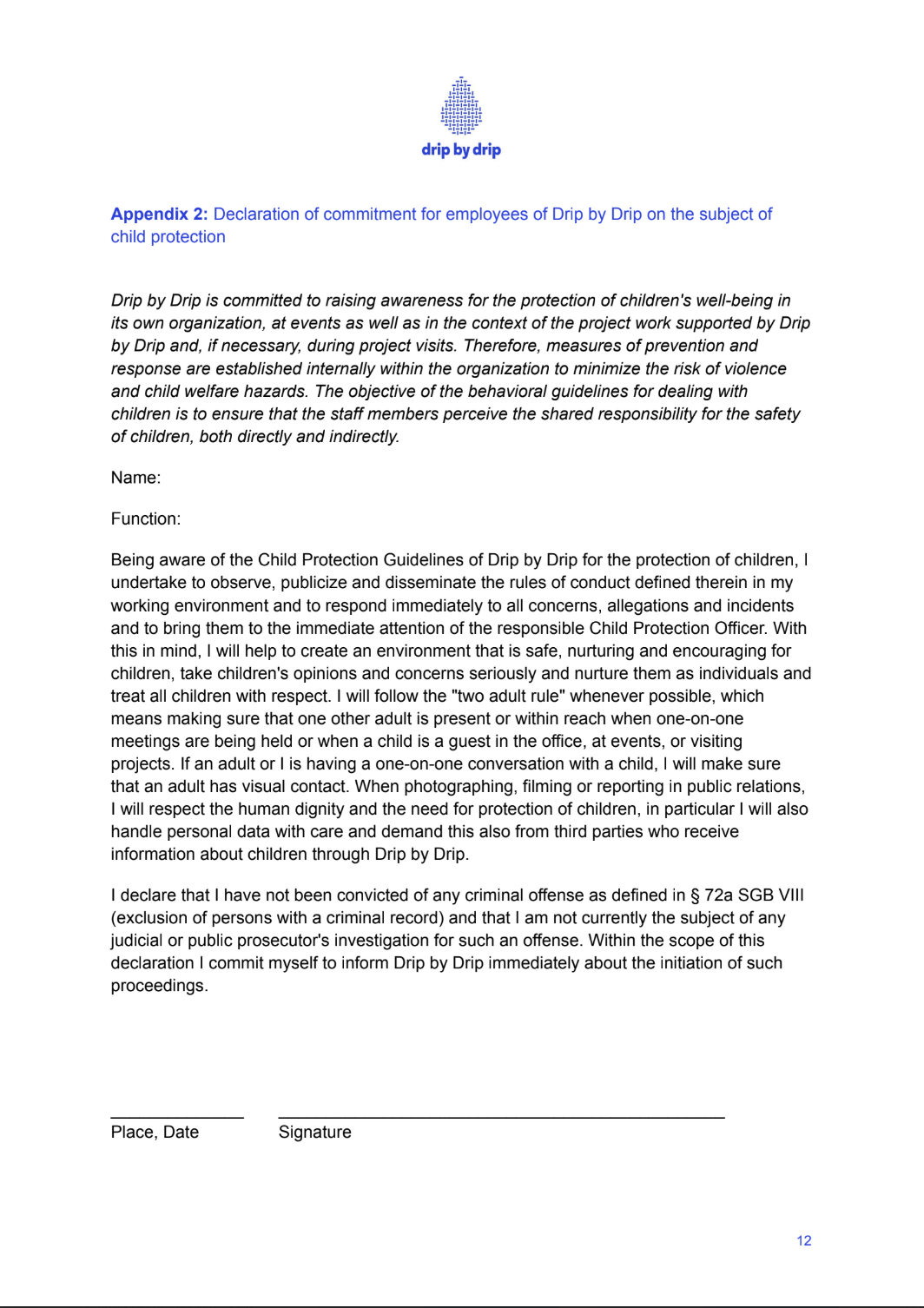
2.1 Declaration of commitment
Drip by Drip is committed to protecting the rights and well-being of children within the
framework of its own activities, to strengthening their promotion and participation, and to
establishing the following standards in its work. In doing so, it aims to,
- to contribute to creating an environment that is safe for children and in which respect
for children’s and human rights is ensured, - to raise awareness of the issue of child protection within Drip by Drip among the staff
of the office and the partners, - to respect the dignity of children in its press, education and public relations work and
to observe the general standards for communication, - to take all suspected cases seriously and to seek immediate advice from a
recognized list of contact points for child protection known to all employees of the
office, - to enter into specific written agreements on child protection with its partner
organizations in the Global South.
2.2 Child protection standards in personnel policies
In an effort to ensure a safe environment for children, Drip by Drip also takes basic
preventive measures within the framework of its personnel management, which are outlined
below. In this context, Drip by Drip is aware that a prudent hiring and selection process
cannot provide 100% protection against the hiring of potential perpetrators. However, a
proactive approach to the issue of child protection signals the high sensitivity of the employer
and thus has a deterrent effect on potential perpetrators.
Recruitment procedure and job evaluation
All employees are required to actively contribute to creating a culture of mindfulness and
safety for the children associated with Drip by Drip’s offerings or services, the organization,
and themselves.
For each position to be filled, it will be checked in advance whether the position holder will
have direct or indirect contact with children. If the duties assigned will result in direct contact
with children, an extended certificate of good conduct will be required. In the interview, the
commitment of Drip by Drip to child protection is mentioned. In this way, the relevance of the
topic of child protection is already made clear in the selection process.
Extended certificate of good conduct
All employees of Drip by Drip who come into contact with children in the course of their work
are required to submit an extended certificate of good conduct. The extended certificate of
good conduct must be resubmitted every five years. Drip by Drip bears the costs incurred for
the regular check and issues the necessary cover letters for the authorities. Indications of a
legally binding conviction in Germany or in another country for a sexual offense against
children or for human trafficking are clear grounds for exclusion from employment.
In addition, all new hires are checked to determine whether an extended certificate of good
conduct is necessary, for example if there is direct contact with children. This necessity is
explained to employees and applicants.
In addition, it is being examined whether it should be introduced for all employees of Drip by
Drip who make foreign service trips that the extended certificate of good conduct is
inspected. The need for an extended certificate of good conduct for employees with foreign service trips is due to the special position they hold and an increased risk of abuse of power associated with it.
Before outgoing professionals and volunteers, as well as people who deal with children on
behalf of Drip by Drip, are placed, they must always present an extended certificate of good
conduct.
Staff development
All employees are sensitized to the topic of child protection and receive ongoing training in
accordance with their tasks and functions. Child protection also plays an integral role in the
onboarding of new employees and other information days on strategic topics. Particular
attention is paid to training project staff who are involved in the partner dialog. In addition,
HR managers must ensure that employees traveling abroad are sensitized to the issue of
child protection.
2.3 Child protection standards in communication
In order to protect the children and young people involved in the activities of Drip by Drip
from danger, violence or stigmatization, Drip by Drip demands that any production and
distribution of media content respects the dignity of children and protects their identity. The
association therefore obligates all reporters to observe the following general communication
standards and data protection principles to protect the welfare of children.
All media content is based on the values of respect and equality and upholds the dignity of
the person portrayed. Children are portrayed as personalities with many facets and
potentials. Reduction to a victim or other stereotypical roles is avoided. Before creating
media content and project documents on which children are depicted, such as flyers or
proofs of use, the children concerned and their parents/guardians are to be informed in an
understandable way about the purpose and use and their consent is to be obtained. The
privacy of all persons in projects and in the project environment shall be respected at all
times. Thus, pseudonyms are always to be used for the children, unless the naming of the
child is in the interest of the child in question and is done with the consent of the child and
his/her parents/guardians. The description of the children’s life situation is made against the
background of their social, cultural and economic environment in order to show the
complexity of the context.
3. Intervention – complaint mechanism and case management
3.1 Objectives
Drip by Drip has a complaints mechanism, i.e. an institutionalized procedure for dealing with
indications of a threat to the welfare of children/abuse/sexualized violence and other
violations of legal requirements.
Through the Drip by Drip complaint mechanism, reports of suspected cases can be received
and processed in a qualified and targeted manner. The Drip by Drip complaint mechanism
enables:
- identify cases of child welfare endangerment at an early stage,
- initiate an appropriate response to the respective situation in the event of suspected
cases, and - initiate necessary measures to protect the best interests of the child.
The basis of all decisions on child-related suspected cases within the complaint
management system is the well-being and protection of the children. The flow of information
to relevant stakeholders is ensured through transparent documentation. The Drip by Drip
complaints mechanism is made known to all Drip by Drip employees and all contact persons
inside and outside the organization, and the relevant procedures are communicated.
3.2 Dealing with suspected cases
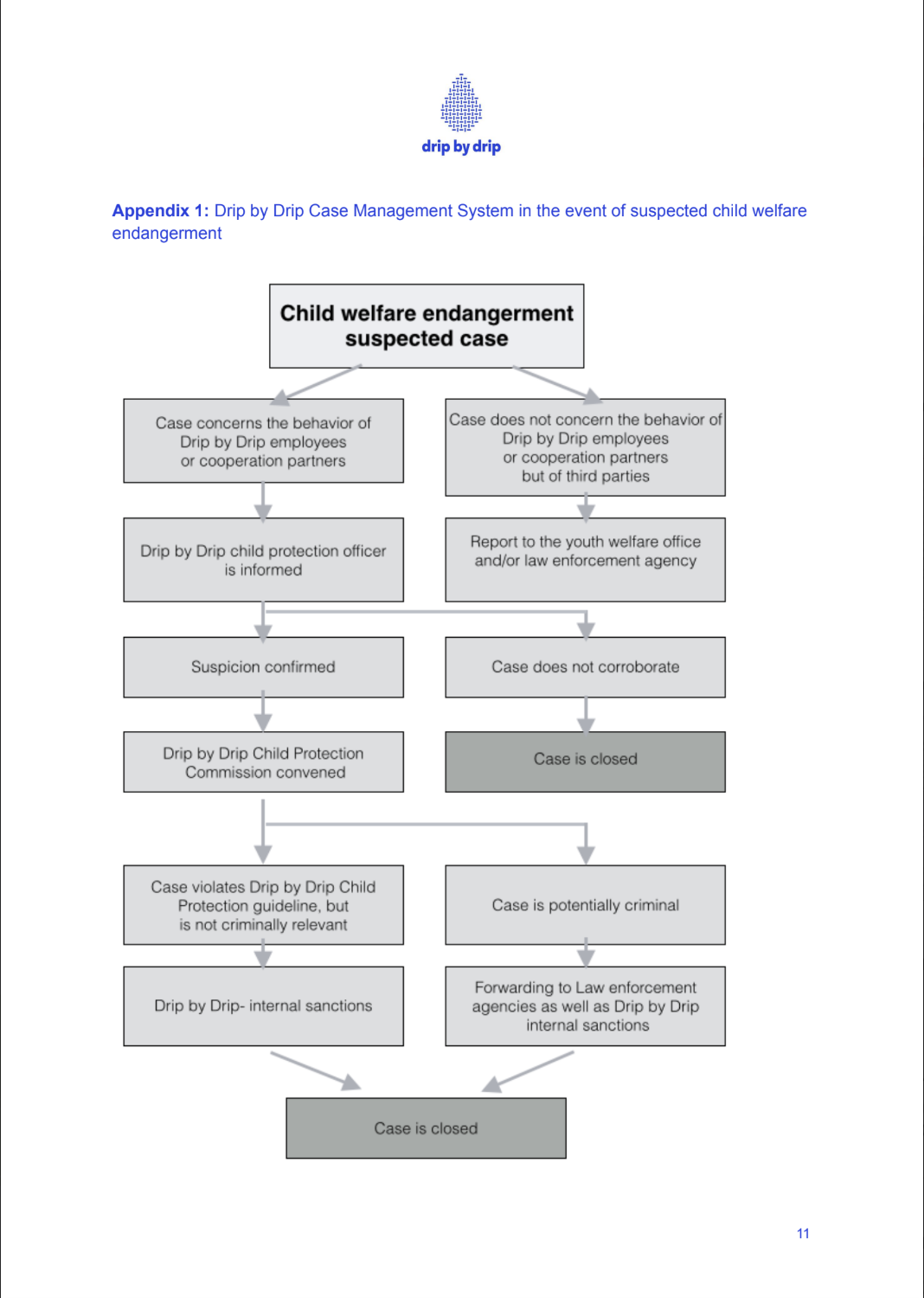
Drip by Drip has an institutional system for dealing with (suspected) cases of child welfare
endangerment (see Appendix 1). The aim of the case management system is to enable an
adequate and quick clarification of the respective situation in suspected cases and to identify
cases of child welfare endangerment at an early stage. It also aims to ensure that affected
children are protected and have access to special assistance services in order to prevent
further harm to them. This system is known to all employees of the office and is to be applied
without exception.
If a (suspected) case is brought to the attention of the association, the person responsible for
child protection is obliged to follow the case management system of the association. She/He
is obliged to pick up and clarify all (suspected) cases. Based on the information, the child
protection officer shall then immediately make a decision on how to proceed. As far as
possible, the case shall be discussed with at least one colleague in the office. The procedure
is to be documented.
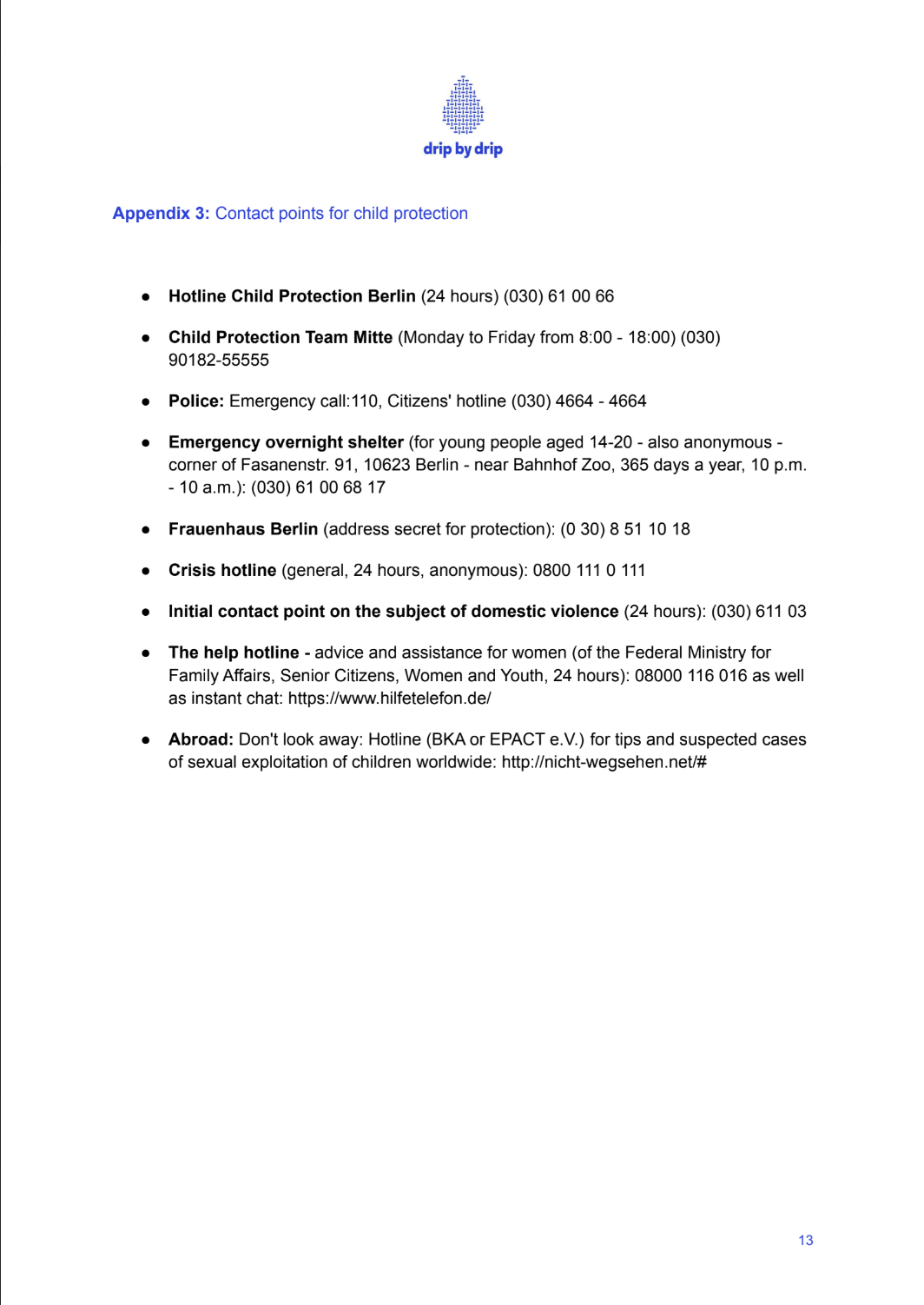
Information should be forwarded to at least the following offices (see Appendix 3):
a) In the event of a criminal offense and persistent danger to the child, information is
provided to the local youth welfare office or a report is made to the police.
b) and contact will be established between the responsible body, care services and, if
applicable, the child/children concerned as well as their legal guardians, if this has not
already been done.
Suspicion case with employees of the office of Drip by Drip:
If there are indications of a risk to the well-being of a child by an employee of the office of
Drip by Drip or its honorary staff, this must be reported immediately to the managing director
or the respective chairperson. The latter will then take the steps described under a) and b) in
accordance with the case management system.
Suspicious cases involving employees of a partner institution in the Global South:
In principle, Drip by Drip is responsible for case management. A written documentation of all
occurring cases by the person responsible for child protection of Drip by Drip is obligatory.
Corresponding (suspected) cases are to be handled according to a) and b). Depending on
the national legislation, the association is obligated to report the incident to the locally
responsible authorities if those responsible do not act in the sense of safeguarding the best
interests of the child.
With the notification of a (suspicious) case, the association also checks the resulting
consequences for the funding of this project, if necessary up to a reclaim of the grants
already made.
3.3 Protection measures for affected children
Children who are affected by violence by employees of Drip by Drip or persons
commissioned by Drip by Drip need help and support throughout the entire process. As a
matter of principle, care must be taken to ensure that they are adequately informed about
institutional procedures in a manner appropriate to their age and that they are involved in
them to the extent that they are able.
If necessary, trained psychologists are consulted and medical care measures are initiated
and other governmental or non-governmental institutions are involved in order to ensure the
greatest possible protection of the child. This applies in particular to institutional care
facilities. It is ensured that the person under suspicion can no longer have any contact
whatsoever with children, especially with the child in question.
The child’s environment (caregiver and/or family) – if they are not themselves under
suspicion – will be informed immediately and also supported in order to provide the child with
a safe environment. The necessary measures will be arranged by the child protection officer
of Drip by Drip. Necessary financial resources will be provided by Drip by Drip as needed.
This includes the involvement of specialized psychologists to conduct interviews with the children concerned. Interviews with children by members of the child protection team, by persons reporting suspicions or by other Drip by Drip employees are to be avoided because
of the risk of re-traumatization.
The minimum standards formulated here for the protection of affected children also apply to
the independent case management of suspected cases at partner organizations. Drip by
Drip is developing a corresponding handout for partner organizations in which these
standards are defined as minimum requirements.